

When I first launched this Substack, several wondered why I chose the word paradigms as one of the central themes for this space. It’s not a casual word. However, it’s an important idea to help us make sense of the moment we live in—and to help us understand how the Church moved from the patterns of Christ and His Apostles to the wide spectrum of largely fragmented practices we see today. Today’s post is my attempt to make sense of this idea of paradigms, and to give us clarity and hope for navigating the days ahead.1
Why Paradigms?
As Thomas Kuhn explained in his book The Structure of Scientific Revolutions, a paradigm is “the entire constellation of beliefs, values, techniques, and so on shared by the members of a given community.”2 Hans Küng sharpened it even further when he showed that paradigms help define the boundaries, and they tell you how to function successfully within those boundaries.3
Joel Barker, in his talk titled “The Business of Paradigms,”4 talks about paradigms being a set of “rules and regulations” that we subscribe to and use to interpret the world around us and solve problems as they arise. However, it’s often very difficult to see beyond the present prevailing paradigm because the emerging paradigm breaks the “rules and regulations” we’ve learned to live by.
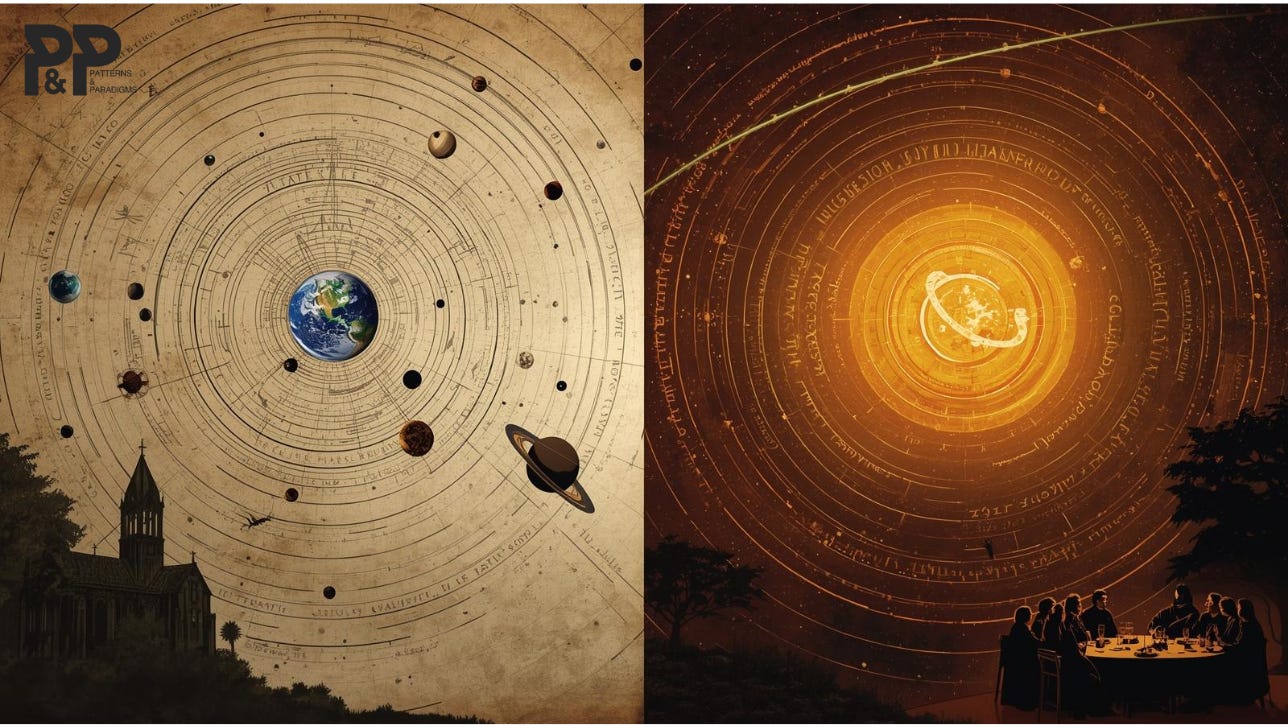
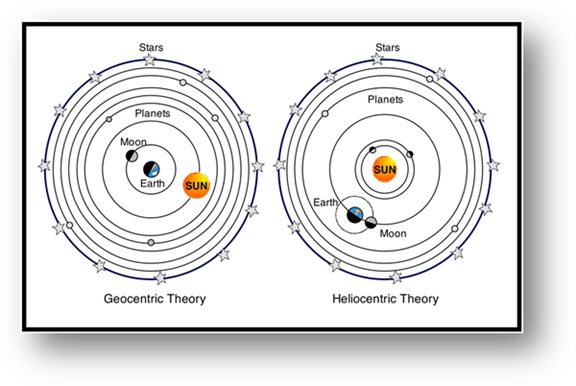
Put more simply, paradigms shape everything. They’re the assumptions that we rarely question, the mental world we often take for granted. In the same way that Copernicus in the 1500s reframed humanity’s place in the cosmos—shifting us from an earth-centered system to a sun-centered one5—paradigms determine what we see as even being possible. When the paradigm shifts, the entire picture looks different, and we’re now able to answer questions that were previously unanswerable and solve problems that until that time had insufficient solutions.
For many years, people have generally operated with the assumption that knowledge simply compiles over time…each generation building upon the previous one. Kuhn instead showed that there are distinct periods of major revolution where everything begins to be approached from an entirely different vantage point.
Paradigms don’t stay fixed. They shift.
Some shifts are subtle. Others are Copernican—so radical that old assumptions collapse and new ways of thinking emerge. According to Kuhn, these kinds of macro paradigm shifts happen every 300-500 years. And when they do, entire worlds of meaning must be rebuilt.
A Drift from the Apostolic Paradigm
After my recent three-part series on Reframing Worship, one frequent comment I received was: “So how did we get to where we are today?” It’s the right question—and one that requires both honesty and historical clarity.
So what happened? How did we drift so far from those early patterns?
The short answer: paradigm shifts. As Christian history unfolded, new paradigms emerged—and each brought both gains and losses.
For 2,000 years, the Church has not simply grown in a linear fashion as some might assume; it has passed through a succession of major paradigm shifts. Hans Küng, building upon the paradigm ideas of Thomas Kuhn, identified six distinct paradigms in Church history, from the Apostolic paradigm all the way to the modern Enlightenment paradigm that still shapes much of Western Christianity.
And now, in our own generation, a new church paradigm is emerging.
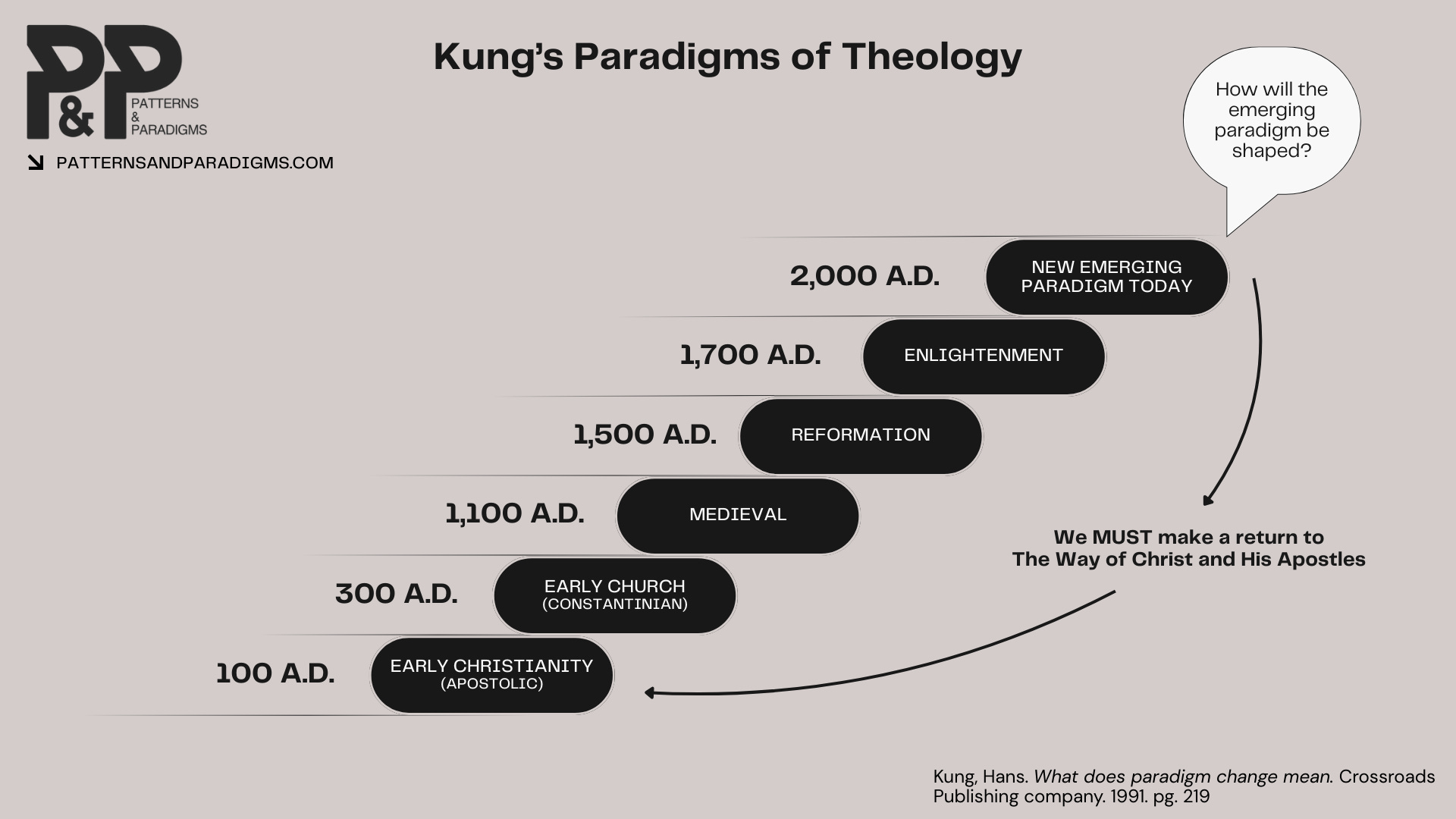
While well-intentioned leaders during each of these paradigm shifts were working hard to remain faithful to Christ’s call, these shifts came at a cost—especially when it came to the relational, communal, and reproducible patterns of the apostolic era.
The Early Church (Constantinian) paradigm elevated institutional power but diminished the household-based, relational patterns of early Christian life.
The Medieval paradigm produced rich theological reflection but layered clergy/laity distinctions that reshaped the DNA of the Church.
The Reformation paradigm recovered Scripture and proclamation but reinforced a sermon‑centric, clergy‑centric model.
The Enlightenment paradigm brought rational clarity but introduced an individualistic and academic view of faith that has shaped most Western churches today.
And now? The Western Church is showing the signs of a church paradigm reaching its limits:
Leaders burning out.
Congregations shrinking.
Division increasing—30,000+ denominations and counting.
Marketplace believers struggling to find their place in a church system dominated by professional/vocational ministers.
Maturity declining—most attending church only 1–2 times a month, with little expectation of growth or maturity.
Meanwhile, movements in places like the global South—many operating much closer to the apostolic paradigm—are exploding with life and multiplication. I believe the church is living in one of those Copernican-type moments. The old paradigm is proving insufficient to answer the questions and solve the problems of our rapidly changing world. A new paradigm is emerging, still not yet fully formed, but unmistakably present. And in between these two worlds, it can be quite disorienting, and people instinctively begin searching for solutions.
Some return to their denominational or secondary church traditions. Others reach back as far as the Reformation, or the early Church Fathers, or the Desert Fathers, or even the Jewish roots of the faith. Many try inventing new and novel models—hoping to find something that might stick.
But there is another (better) option: recover The Way of Christ and His Apostles—as Roland Allen wrote more than a century ago.6 Over the past 50 years, thousands of leaders globally have been working to recover these New Testament ideas and root their churches in this paradigm. Once you begin to see the scripture through this lens, you can easily contrast it with the institutional paradigms that arose over the past 1,700 years. In contrast to what we see—especially in the Western church today—the apostolic era had a fundamentally different way of forming communities, developing leaders, and strengthening the Church.
Recovering the New Testament Paradigm: The Way of Christ and His Apostles
When we study the first-century Church—not as a nostalgic ideal but as a real, functioning network of communities—we find patterns woven deeply into the fabric of their life together.
Training, maturing, and growth was relational and communal, not programmatic.
The local church family was firmly at the center of Christ’s plan.
An integrated framework for gospel proclamation (Evangelism), planting/establishing churches (Mission), and training/raising up leaders (Leadership Development)—all done organically within the context of church family.
Churches met primarily in households—networked together as extended family.
The teaching (“the deposit,” “the faith,” “the sound doctrine”) was handed down in ordered, foundational patterns.
Maturity was expected of every believer—not optional, not outsourced.
These patterns weren’t accidental; they were the patterns the Apostles expected every church family to follow. Through the Holy Spirit’s leading and the Apostles’ traditioning process, they shaped a paradigm designed and intended to thrive in every culture, in every language, in every household, in every church family, across all time.
And the fruit speaks for itself.
From approximately 25,000 followers of Jesus in the mid-first century to nearly 20 million by the early fourth century7—a nearly unimaginable multiplication:
800x growth
80,000% increase
All without:
large cathedrals or auditoriums with a stage
professional clergy systems
multimillion-dollar budgets
seminaries
branding strategies
or weekly events designed for passive spectators
They had a paradigm—a way of life that worked. A way that aligned with the patterns handed down by the Apostles. A way designed for ALL believers to fully mature, lead, and participate locally and globally in Christ’s plan.
Why Recover the Apostolic Paradigm Now?
The reason this matters is simple: the New Testament apostolic paradigm wasn’t a first-century accident—it was a Spirit-designed framework for forming believers in every culture and generation.
When we return to those patterns, something amazing happens. The questions of our moment begin to find new answers—solutions the current paradigm can’t sufficiently provide.
How do we form ALL believers to become mature, resilient participants in Christ’s plan?
How do we develop leaders at every level?
How do we establish churches that function as families on mission rather than audiences consuming religious goods?
How do we as Christians remain faithful in a post-Christian culture?
The apostolic paradigm has answers—because it was designed for precisely these challenges. As Roland Allen argued over 100 years ago, we need a return to The Way of Christ and His Apostles.
Ultimately, the real question isn’t just, “How did we get here?” It’s also: “Where do we go from here?”
And I believe the way forward looks a lot like the original way.
A return—not to nostalgia, not to romanticized history—but to the Spirit‑formed patterns handed down by Christ and His Apostles.
A return to:
communities as extended families on mission
leadership development embedded in everyday church life
ordered teaching that moves every believer towards full maturity
worship expressed and church families built up through everyday one‑anothering
churches that multiply through relational networks
These are all pieces of a paradigm shift emerging in our time—not a new invention, but an ancient pattern becoming visible again.
It may feel like we’re living in a moment of unraveling—but it’s also a time of rebuilding. As with all paradigm shifts, it can feel disorienting—but it is also deeply hopeful. As the Broadway hit Hamilton puts it: “Look around, look around at how lucky we are to be alive right now.”
We live in a moment when the Church has the opportunity to recover its original DNA…the original patterns of Christ and His Apostles.
It’s time to return to the Way of Christ and His Apostles.
This is a paradigm worth rediscovering.
This is a paradigm worth committing our lives to.
Matthew D. Andersen is based in the NYC area and is part of the METRO equipping team, a network of leaders who are establishing churches as families…patterned after Acts.
A very helpful tool that has been utilized among leaders in our global church network is a paper titled Paradigm Curves for Gospel Progress - How to Interpret the Past to Discern the Future, By Michael Vos, CEO of BILD International. In this paper, Michael gives some deeper insight into paradigm ideas, why they are important for us today, and how we can use paradigm curves to track progress in our paradigm work. You can download a PDF copy of this paper here.
Thomas S. Kuhn, The Structure of Scientific Revolutions, 2nd ed. (Chicago: University of Chicago Press, 1970), Page 75.
Küng, Hans. What Does “Paradigm Change” Mean? New York: Crossroad Publishing, 1991.
The Business of Paradigms,” YouTube video, [38:28], posted by ROLMAlumni Atlanta, December 12, 2022 The Business of Paradigms,” YouTube video, [38:28], posted by ROLMAlumni Atlanta, December 12, 2022
The Copernican Revolution – 1543
This term, originally used by Roland Allen in the early 20th century, has been used by many leaders globally over the past 50 years to describe the NT Apostolic paradigm that is re-emerging centuries later. It’s a multi-faceted, integrated framework that I’m not even sure Roland Allen fully understood. He did, however, clearly understand that our current methods and practices were quite different from those we read about in the scriptures.
“People have adopted fragments of St. Paul‘s method and have tried to incorporate them into alien systems, and the failure which resulted has been used as an argument against the Apostle‘s method.… When these false and partial attempts at imitating the Apostle‘s method have failed, men have declared that the apostolic method was at fault and was quite unsuited to the condition and circumstances of present-day missions. The truth is that they have neither understood nor practiced the Apostle‘s method at all.”
“St. Paul‘s method is not in harmony with the modern Western spirit.… We cannot imagine any Christianity worthy of the name existing without the elaborate machinery which we have invented.”
Roland Allen, Missionary Methods: St. Paul’s or Ours? (Grand Rapids: World Dominion Press; Wm. B. Eerdmans Publishing, 1962), 5–6
Um, Stephen T., and Justin Buzzard. Why Cities Matter: To God, the Culture, and the Church. Wheaton, IL: Crossway, 2013.